
Originally Published: December 17, 2020 | Updated: April 2, 2026
• Why the Clock is Ticking on Your Employment Claim
• Filing Deadlines in Washington, D.C.
• Filing Deadlines in Virginia
• Filing Deadlines in Maryland
• When Does the Clock Start Running?
• Frequently Asked Questions (FAQ)
• Don’t Wait — Protect Your Rights
In employment law, timing is everything. If you believe your employer has violated your rights, you have a limited window of time to take legal action. This deadline is called the statute of limitations. If you miss it, you can lose your right to sue forever, no matter how strong your case is.
This guide breaks down the critical deadlines you need to know for filing an employment lawsuit in Washington, D.C., Virginia, and Maryland.
Why the Clock is Ticking on Your Employment Claim
A statute of limitations is a law that sets a strict time limit on your right to bring a legal claim. These laws exist to ensure that cases are brought forward while evidence is still fresh and witnesses’ memories are reliable.
For employees, this means you cannot wait to act. The clock starts ticking from the moment the illegal action (like being fired, demoted, or harassed) occurs. Waiting too long can be a fatal mistake for your case.
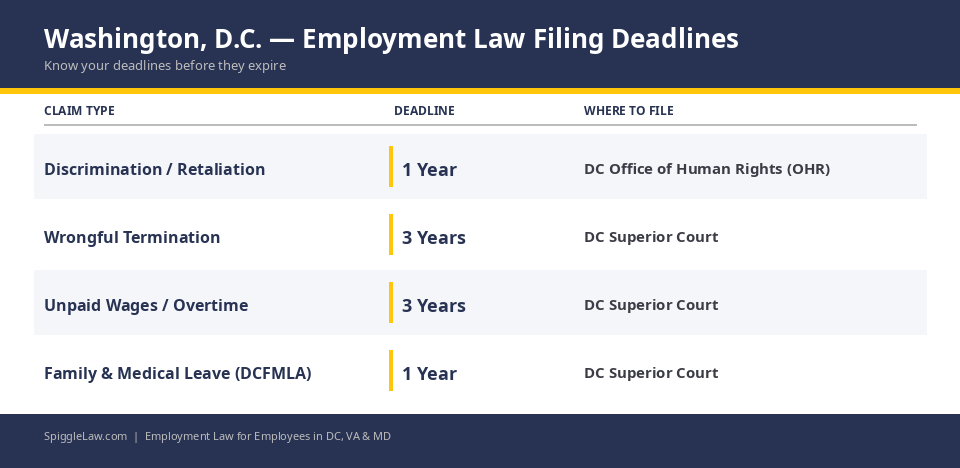
Filing Deadlines in Washington, D.C.
Washington, D.C. has some of the most employee-friendly laws in the country, but the deadlines are still absolute. You must file a complaint with the D.C. Office of Human Rights (OHR) or directly in court, depending on the claim.
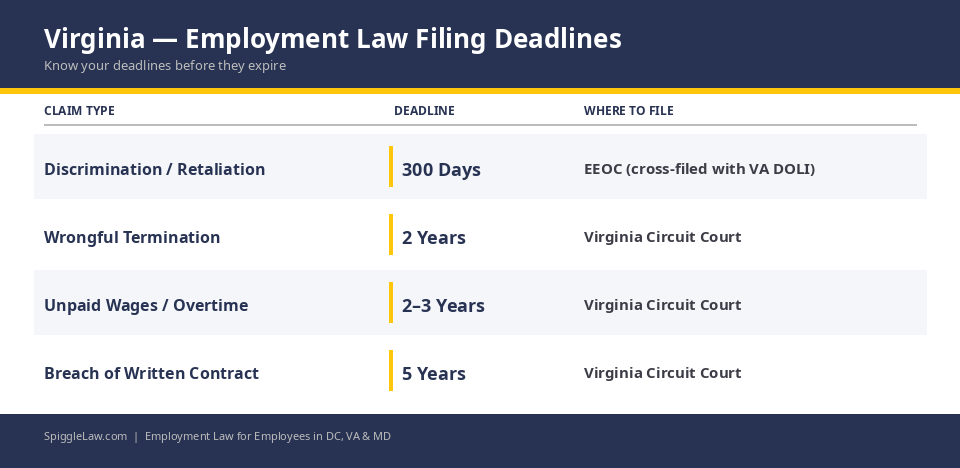
Filing Deadlines in Virginia
Virginia employees must navigate a mix of federal and state laws. For most discrimination claims, you must first file a “charge” with the Equal Employment Opportunity Commission (EEOC).
Filing Deadlines in Maryland
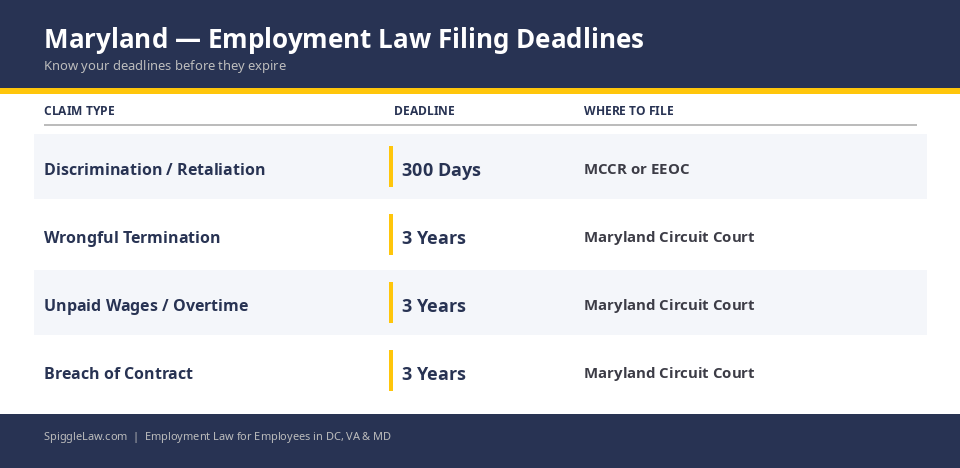
Like Virginia, Maryland employees typically must start with an agency filing at either the EEOC or the Maryland Commission on Civil Rights (MCCR).
When Does the Clock Start Running?
The deadline clock generally starts on the day the adverse action occurred. This could be:
•The date you were fired.
•The date you were informed of a demotion.
•The date of the last act of harassment.
•The date you received a paycheck that was illegally short.
In some limited situations, the “discovery rule” may apply, which means the clock doesn’t start until the date you reasonably should have known about the illegal act. However, you should never rely on this exception. Always act based on the date the incident happened.
Frequently Asked Questions (FAQ)
Q: What happens if I miss the statute of limitations?
A: If you miss the deadline, your case will almost certainly be dismissed. The court or agency loses its jurisdiction to hear the case, and you lose your right to recover any damages.
Q: Is the EEOC deadline 180 or 300 days?
A: The federal deadline is 180 days, but it extends to 300 days in states like Virginia and Maryland that have their own state anti-discrimination agencies (MCCR, Virginia DOLI) that cross-file with the EEOC. To be safe, always aim to file as early as possible.
Q: Can my employer and I agree to extend the deadline?
A: No. The statute of limitations is set by law and cannot be changed by a private agreement. The only exception is a formal “tolling agreement,” which is a legal document that must be drafted by an attorney.
Q: Does filing an internal HR complaint stop the clock?
A: No. Filing an internal complaint with your company’s Human Resources department does not pause or “toll” the legal statute of limitations. You must file with the appropriate government agency or court before the deadline expires.
Don’t Wait — Protect Your Rights
The most common mistake employees make is waiting too long to seek legal help. Evidence disappears, memories fade, and legal deadlines expire. If you believe your rights have been violated, it is critical to speak with an experienced employment attorney immediately.
Contact The Spiggle Law Firm today for a confidential review of your case.
References
[1] DC Office of Human Rights. (n.d.). Complaint Process & Timeline. Retrieved from
[4] Maryland Commission on Civil Rights. (n.d. ). Timeliness. Retrieved from